10 hr 30 min
Five-Island Speedboat Adventure: Blue Cave, Vis, Hvar & More
Explore Croatia's stunning Adriatic islands on a full-day speedboat journey with swimming, sightseeing, and cave visits
Reserve
Hand-picked by our editors — only the best 5 speedboat excursions from 12 reviewed.
Verified partners for every tour, free cancellation where available, and instant confirmation on every booking.
10 hr 30 min
Explore Croatia's stunning Adriatic islands on a full-day speedboat journey with swimming, sightseeing, and cave visits
Reserve
10 hr 30 min
Discover Dalmatia's most stunning islands on a small-group speedboat journey with cave exploration and beach stops
Reserve
11 hr
Cruise to Croatia's stunning islands, explore the glowing Blue Cave, and snorkel in crystal-clear lagoons
ReservePrices from verified partners. Availability updates in real time at checkout. Free cancellation policies apply where shown.
The landmarks, rooms, and views travelers on this tour remember — all visible on a single visit.
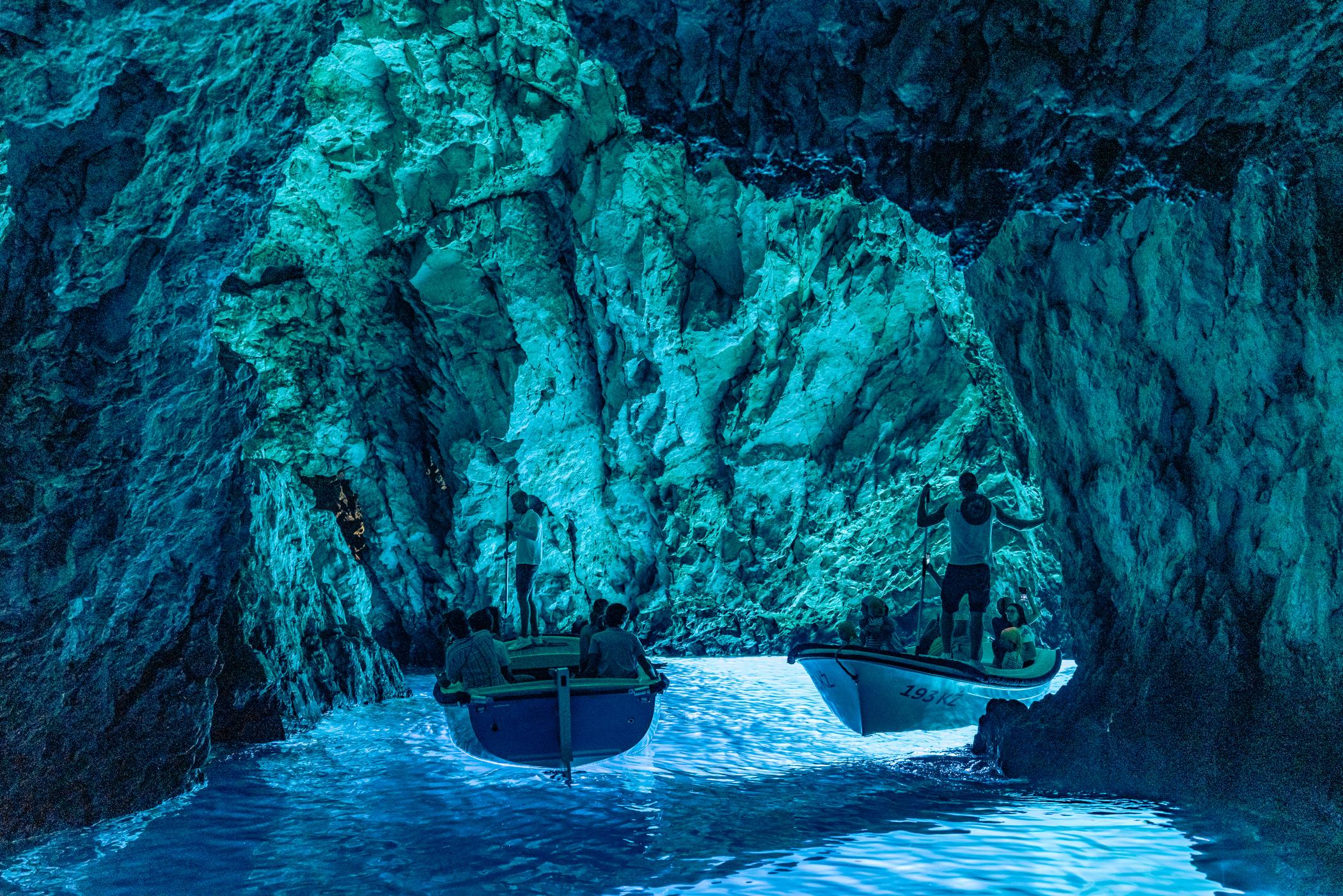
The primary limestone archway leading to the sea grotto where sunlight reflects off the sandy floor to create a neon blue glow.
These two sites are geographically distinct and offer different maritime experiences, so travelers should confirm the specific coastal region before securing their budva boat tour to blue cave tickets. Most visitors find that the Montenegrin cave provides a more accessible coastal excursion while the Croatian site requires a longer journey for its unique limestone grotto illumination.
| Feature | Top pick Blue Cave (Montenegro) | Biševo Blue Cave (Croatia) |
|---|---|---|
Geographic Location |
Luštica Peninsula, Montenegro | Biševo Island, Croatia |
Access Point |
Budva or Herceg Novi | Vis Island or Split |
Cave Characteristics |
Natural grotto with light reflection | Limestone cave with blue luminescence |
Entry Logistics |
Accessible only by boat | Requires organized boat transfer |
Main Differences |
Part of wider Boka Bay itinerary | Isolated site focused on optical effects |
| See tickets → |
Verdict: Choosing between these budva boat tour to blue cave tours and the Croatian alternative depends entirely on whether your itinerary is centered in Montenegro or the Dalmatian coast, as neither location offers an easy transit connection to the other.
Choose your ticket, select your date, and reserve in under two minutes. Secure checkout handled by our verified partner.
Instant confirmation by email, with a mobile voucher you can save offline. No printing, no queuing at a collection desk.
Arrive at the entrance, show your voucher on your phone, and walk in. Most tickets include priority or skip-the-line access.
Practical details for your visit straight from our verified partners — hours, access, rules, and how to get there.
Wear swimwear and comfortable beach clothing. Bring a light cover-up or towel for your budva boat tour to blue cave trip.
Keep belongings minimal. Use waterproof bags to protect electronics during your budva boat tour to blue cave adventure.
Bring a waterproof camera or phone pouch to capture the unique light inside the cave. The blue illumination is most vivid during the best arrival window of 10:00–14:00.
Access to the Blue Cave is via boat only. The experience often requires jumping into the water from the vessel.
The cave is a memorable spot for families, but children should be confident swimmers. Life jackets are provided on every budva boat tour to blue cave.
Most excursions provide water, but check if your specific operator allows snacks. Avoid bringing heavy meals on a budva boat tour to blue cave.
Best time to go, insider tips, nearby landmarks, and the cancellation fine print — flip through to skim what matters to you.
Flexible, no hidden fees.
Full refunds are typically available for any budva boat tour to blue cave if cancelled at least 24 hours in advance. Please refer to your specific operator's terms regarding the 0 EUR entrance fee.
The Blue Cave's signature illumination depends on a single variable: the angle at which morning sunlight penetrates a submerged limestone fissure on the Luštica Peninsula's western flank. Between 10:00 and 14:00, when the sun reaches optimal elevation above the Adriatic horizon, incoming rays refract through the cave's seawater entry and scatter across its calcite walls, bathing the interior in an electric cobalt glow. Outside that window, the chamber reverts to shadow. The cave's geological formation began roughly two million years ago, when tectonic pressure fractured the peninsula's sedimentary layers and sea-level oscillations carved out the present-day grotto. Unlike most coastal caves accessible by foot, this one offers no terrestrial entrance — visitors arrive exclusively by private vessel or organized speedboat, a constraint that has preserved its pristine state. Montenegro's Adriatic coastline hosts fewer than a dozen such submerged grottos, yet the Blue Cave's particular geometry — a narrow aperture beneath the waterline, a dome-shaped chamber above — creates the rare optical conditions that produce its trademark color. The phenomenon is neither bioluminescent nor artificial; it is purely refractive, contingent on clear weather and calm seas. During summer months, when the Adriatic's transparency peaks, visibility inside the cave can exceed eight meters, revealing the limestone's granular texture and the occasional school of damselfish drifting through shafts of light. The cave lies within a protected marine zone, and Montenegro's environmental regulations limit motorized entry to daylight hours, prohibiting anchor drops within a 50-meter radius. Budva boat tour to blue cave departures cluster in the early morning, timed to reach the peninsula before midday crowds. Most speedboat routes pair the cave with secondary stops — Mamula Island's Austro-Hungarian fortifications, the sandy cove at Žanjice, or the longer cross-water passage to Vis and Hvar in Croatian territory. These multi-island itineraries typically span six to eight hours, with the Blue Cave allocated a 20- to 30-minute swim-and-photograph window. Tour operators depart from Budva's main marina, where a fleet of rigid inflatable boats and fibreglass speedboats stage between 08:00 and 09:30. The outbound crossing covers approximately 12 nautical miles, traversing open water before threading through the Luštica Peninsula's southern coves. Entry to the cave itself remains free, a policy enforced by Montenegro's Ministry of Sustainable Development, though access hinges on securing a seat aboard a licensed vessel. The cave's chamber measures roughly 15 meters in diameter, with a ceiling height of nine meters at its apex, large enough to accommodate two or three boats simultaneously but small enough that congestion during peak summer weeks — late July through mid-August — can compress individual visit times to under ten minutes. Outside those windows, the cave reverts to the quiet rhythm of the peninsula: fishing skiffs at dawn, the occasional yacht anchoring offshore, and the low hum of a budva boat tour to blue cave tickets securing the next morning's departure.

"Between 10:00 and 14:00, incoming rays refract through the cave's seawater entry and scatter across its calcite walls, bathing the interior in an electric cobalt glow."
A step-by-step walkthrough of the visit — what you'll see, how long each stage takes, and the details that matter.
You board the speedboat at Budva's main marina shortly after 08:30, stepping over coiled mooring lines and stowing your daypack in a dry compartment beneath the bow seating. The skipper throttles up as the harbour breakwater recedes, and within minutes the boat planes across open water, the Adriatic's surface rippling in long, glassy swells. The outbound crossing takes 40 minutes, the coastline shrinking to a low ochre smudge as the Luštica Peninsula's cliffs rise ahead. You round the peninsula's southern tip, where the water deepens to a cold, transparent indigo, and the boat slows as the cave's entrance comes into view — a dark crescent notched into the rock face, waves lapping at its submerged threshold. The skipper cuts the engine and drifts into the grotto's mouth, the hull scraping lightly against the limestone as you duck beneath the low overhang. Inside, the chamber opens into a vaulted dome, and the water beneath the boat glows a luminous, electric blue, as if lit from below. You slip over the side, the cold shocking your skin, and float in the charged light, watching it pulse and shift with each swell. The cave amplifies every sound — your breath, the slap of water against stone, the low voices of other swimmers. After 20 minutes, the skipper signals, and you pull yourself back aboard, salt drying in white streaks across your arms as the boat pivots toward open water and the next island anchorage.
The Blue Cave is open daily from 00:00–23:59, though operations depend on sea conditions.
There is no entrance fee (0 EUR) for the cave itself, but you must pay for your boat transport.
The optimal sun angle for the cave's blue light illumination effect is 10:00–14:00.
Yes, families are welcome, provided children are confident swimmers and supervised.
Yes, swimming is the primary way to experience the cave, with boats anchoring nearby.
You can book a boat tour departing from Budva Marina for your budva boat tour to blue cave.
Bring swimwear, a towel, sunscreen, sunglasses, and a waterproof bag for your electronics.
Yes, photography is highly encouraged to capture the glowing blue water.
Captains reserve the right to cancel any budva boat tour to blue cave if sea conditions are unsafe.
Availability varies, but we recommend booking your budva boat tour to blue cave tickets in advance during peak summer.